
THE RAND WATER FOUNDATION
WATER USE EFFICIENCY INITIATIVES: STRENGTHENING COMMUNITIES THROUGH DOMESTIC WATER LEAKS REPAIRS AND EDUCATION ON WATER CONSERVATION.
Water is fundamental to life and economic development. In a water-scarce country such as South Africa, the protection of every drop of clean water is both an environmental responsibility and a socio-economic imperative. Yet millions of litres of treated water are lost daily through leaking taps, burst pipes, ageing infrastructure and inadequate maintenance. While individual households leaks may appear insignificant, their cumulative impact places severe strain on municipal systems, public finances and already limited water resources.
Recognising the urgency of this challenge, the Rand Water Foundation has intensified its integrated water loss mitigation programme, strengthening the water conservation and leak management programme and ramping up Community Education on Water-Use Efficiency in partnership with Johannesburg Water. Water-use efficiency campaigns were rolled out across a diverse urban landscape, including Naledi, Crosby, Wilgespruit, Marikana, Cosmo City, Doornkop, Dobsonville, Protea Glen Extension 16, Orlando West and Diepkloof in Johannesburg Metropolitan Municipality. These targeted interventions resulted in 173 job opportunities created, reaching 48,000 households through leaks repairs coupled with and extensive community educational engagements across schools, homes and public spaces.
Johannesburg Water supplies approximately 1.6 billion litres of potable water daily, largely sourced from Rand Water. However, more than 46% of this volume is classified as non-revenue water lost through leaks, theft or unbilled consumption. This equates to roughly 740 million litres per day that the municipality pays for but cannot recover financially. Addressing these inefficiencies is essential to strengthening municipal sustainability, improving revenue recovery and safeguarding scarce water resources.
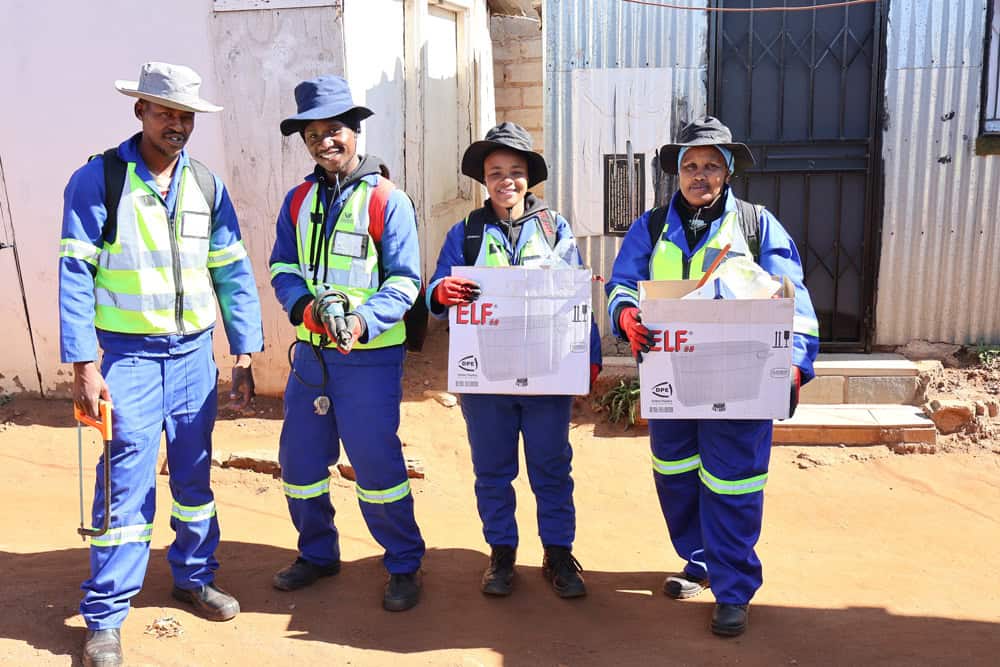
Water conservation and leaks management programme extend beyond awareness campaigns to include direct, practical interventions. These include door-to-door leak inspections, identification of dripping taps and leaking toilets, on-site plumbing repairs and escalation of major infrastructure issues to municipal authorities. The programme moves beyond awareness into implementation, combining community-based inspections, immediate repairs, and formal escalation mechanisms to municipalities to ensure sustainable infrastructure resolution.
A single dripping tap can waste thousands of litres annually, while a leaking toilet can waste significantly more. Multiplied across entire communities, these losses become substantial. By repairing minor households leaks and encouraging behavioral change, the initiative addresses water loss at its source. Rand Water Foundation has successfully implemented these Water Use Efficiency initiatives in Emfuleni Local Municipality, Rand West City Local Municipality, the City of Johannesburg and Mogale City Local Municipality. The results to date showcase 1,534 houses retrofitted in the Palm Springs area of Emfuleni Local Municipality; 1,510 households retrofitted and inspected within Rand West City Local Municipality; 1,013 houses retrofitted in Mogale City Local Municipality; 184 houses retrofitted to date in the City of Johannesburg, with activities ongoing. In total, 4,241 households have been retrofitted across the four municipalities reflecting measurable progress in promoting water use efficiency across Gauteng municipalities.
It is evident from community members that this is an impactful investment as Mr. Thabo Mokoena, a resident of Diepkloof Zone 5 (Ward 27), describes the programme as transformative for local households. “Prior to its implementation, many residents lacked awareness of water scarcity, the financial and environmental consequences of wasteful consumption”, says Mr. Mokoena. Importantly, many households have reported noticeable reductions in monthly water bills, demonstrating that conservation practices can ease financial pressures while promoting sustainability. The initiative has fostered intergenerational learning, engaging children, parents and elders in shared responsibility for water stewardship.
Another defining feature of the Programme is contribution to local economic development through creation of jobs and empowerment of young people for new venture creation. Local youths were employed as education facilitators, providing income opportunities alongside valuable skills development, while others went ahead and started new businesses in the plumbing space. As facilitators participants conducted household visits and audits and delivered educational workshops as ambassadors for water conservation within their communities.
This approach not only addressed youth unemployment but moreover nurtured emerging community leaders. Collaboration with key leaders such as ward councilors further strengthened outreach efforts, ensuring broader dissemination of information, even among residents unable to attend formal sessions. Community feedback has been overwhelmingly positive. Reported outcomes include cleaner neighborhood environments, reduced households’ leaks, increased awareness of water conservation, lower households water bills and improved reporting of infrastructure faults.
Non-revenue water remains one of the most pressing challenges facing municipalities nationwide. By integrating education, practical leak repairs, job creation and community ownership, the Domestic Water Leaks Repairs initiative demonstrates that sustainable water management begins at household level. In a country confronted by deepening water scarcity, protecting every drop is not optional, it is essential. Through strategic partnerships, practical interventions and empowered communities, the Rand Water Foundation continues to demonstrate that sustainable change is achievable when citizens are informed, equipped and inspired to act.
The General Manager of the Rand Water Foundation Mohlatleho Sekoaila expressed sincere appreciation to all partners, beneficiaries, and the dedicated Rand Water Foundation team for their role in successfully delivering the Water Use Efficiency Programme with distinction. Ms Sekoaila highlighted that the intervention did not only reduce water losses through leaks repairs and improved households water use efficiency but moreover strengthened community awareness around responsible water use. The General Manager emphasised that the achievement reflects the power of collaboration and reaffirmed the Foundation’s continued commitment to supporting the core business of Rand Water.
Because when it comes to water security — every drop truly counts.