

TURNS 180 YEARS OLD
Snapshots from The Witness’ First Century
From a colonial printing press to a changing world
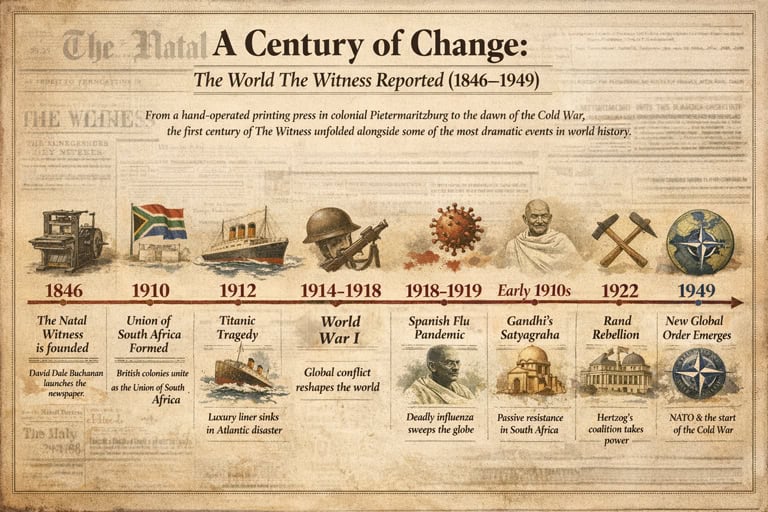
In a young colonial town surrounded by rolling hills and wagon tracks, a small printing press began producing a newspaper that would grow into one of South Africa’s longest-running publications — The Natal Witness.
Founded in 1846 in Pietermaritzburg by Scottish immigrant David Dale Buchanan, the paper was created to serve a developing British colony that was hungry for information about politics, trade and daily life.
Printing a newspaper in the mid-19th century was painstaking work. Every letter had to be set by hand using small metal type before pages could be printed on a manually operated press. Early editions were usually four pages long, filled with dense columns of text and printed only once a week.
Circulation was small — only a few hundred copies — but the newspaper quickly became an important forum for settlers to follow developments in the colony, debate ideas and track the growth of their community.
Advertising also appeared in those early pages, promoting everything from cattle and wagons to land sales and general stores.
Though modest in scale, those early editions documented the story of a colony finding its feet.
A world in turmoil
By the early 20th century, the world — and South Africa — was entering a period of dramatic transformation.
The decade from 1910 opened with the formation of the Union of South Africa, uniting the colonies of the Cape and Natal with the former Boer republics of the Transvaal and the Orange Free State into a single dominion of the British Empire.
The political settlement that followed largely excluded Black South Africans from meaningful participation in government, laying the foundations for decades of institutionalised racial inequality.
Beyond the region, readers would have followed extraordinary global developments. In 1910, Halley’s Comet swept across the skies, capturing the world’s imagination.
Two years later, tragedy struck when the passenger liner RMS Titanic sank in the North Atlantic after striking an iceberg, claiming more than 1 500 lives and prompting sweeping maritime safety reforms.
The decade would soon be overshadowed by an even greater catastrophe. The assassination of Archduke Franz Ferdinand in 1914 sparked the outbreak of World War I — a conflict that engulfed much of the globe and reshaped international politics.
As the war drew to a close in 1918, the world was struck by another disaster: the Spanish flu pandemic, which infected hundreds of millions and killed tens of millions worldwide.
Struggle, labour and politics
The 1920s brought another period of upheaval in South Africa, marked by labour unrest, rising nationalism and deepening racial segregation.
One of the most dramatic events of the decade was the Rand Rebellion of 1922, when white mine workers on the Witwatersrand launched a violent uprising against plans to replace them with cheaper Black labour.
The revolt was eventually crushed by the government of Prime Minister Jan Smuts using troops, artillery and aerial bombardment — an extraordinary escalation that left a lasting mark on the country’s labour politics.
Two years later, political power shifted when JBM Hertzog’s National Party entered government in coalition with the Labour Party, promoting policies designed to protect white workers and advance Afrikaner interests.
During this period, laws such as the Industrial Conciliation Act entrenched segregation by recognising white trade unions while largely excluding Black workers from labour protections.
At the same time, resistance movements were also growing. The African National Congress expanded its activism during the decade, while the South African Communist Party was founded in 1921 as one of the country’s earliest multi-racial political organisations.
A changing post-war world
By the late 1940s, the world was emerging from the devastation of World War II and entering a new geopolitical era.
The pages of The Witness in 1949 reflected this period of uncertainty and change, carrying reports on the shifting alliances that would define the early Cold War.
Readers would have encountered headlines about the formation of the North Atlantic Treaty Organisation (NATO) and the tense political climate in post-war Germany.
Closer to home, the newspaper chronicled civic life in Pietermaritzburg — from community debates and court proceedings to social announcements such as weddings and sporting events.
Even the everyday realities of economic life appeared in its pages, including reports on rising prices for staples such as tinned milk — a reminder that some news themes never change.
A century of witness
From its humble beginnings on a hand-operated press in 1846 to reporting on the global tensions of the post-war era, The Witness spent its first hundred years chronicling a rapidly changing world.
Those early decades saw wars, political upheaval, social movements and technological change reshape societies across continents.
Through it all, the newspaper remained a constant presence in Pietermaritzburg — documenting history as it unfolded and connecting local readers to events far beyond the city’s hills.
Nearly two centuries later, those early pages remain a powerful reminder of journalism’s enduring role: to bear witness to the moments that shape our world.