

TURNS 180 YEARS OLD
Message from the Editor, Riquadeu Jacobs
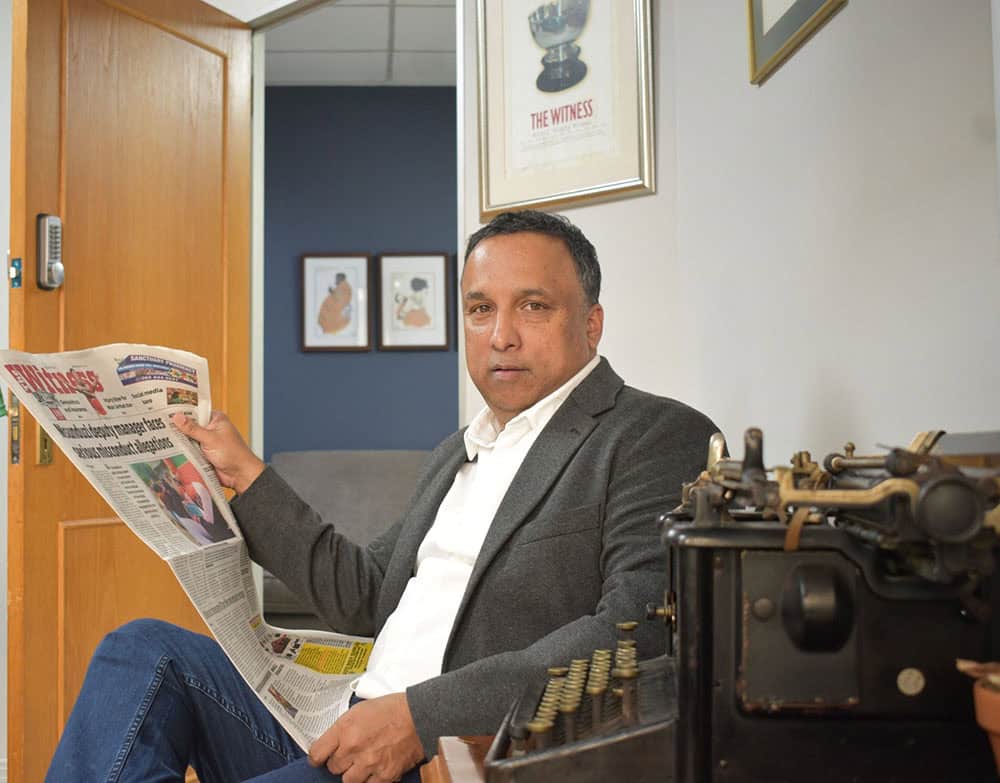
The 180th anniversary of The Witness could not have come at a more important time for the newspaper.
Previous milestone supplements have, quite understandably, leaned heavily into the paper’s long and layered history, tracing its origins back to 1846 and the founding vision of David Dale Buchanan. That history matters. It gives the institution depth, continuity and a sense of place.
But before inevitably returning to the past — as this piece will — it is necessary to first fully record the present.
The environment in which newspapers operate has shifted fundamentally and continues to evolve at pace. The digital transition is no longer new; it has been underway for years. What we are now experiencing is a further wave of disruption, shaped by the Fourth Industrial Revolution — including artificial intelligence, large language models and machine learning — all of which are transforming how information is generated, processed and consumed, and how audiences engage with news.
The rise of AI-driven search, alongside platforms such as TikTok, Instagram Reels and Threads, has reorganised how information is consumed. Content is shorter, faster, often stripped of context and increasingly consumed without direct engagement with original sources. Audiences are no longer necessarily reading the full story — they are encountering fragments of it. We are in the era of fake news where the misuse of AI has been weaponised impacting communities, institutions and even global events.
For newspapers, and for journalism more broadly, this is a precarious moment.
We are operating in an environment where misinformation spreads rapidly, where narratives form in real time, and where verified reporting competes with unverified content on equal footing. The economics of the industry remain under pressure, and the traditional pathways between publisher and reader are being disrupted.
And yet, the need for credible journalism has not diminished. It has increased.
It is at this point that The Witness finds itself marking a significant milestone, while also actively engaged in national industry discussions aimed at finding practical responses to these challenges.
These engagements go beyond questions of sustainability and speak to a deeper reassessment of journalism itself: whether it should be treated purely as a commercial enterprise or recognised as a public good essential to a functioning society.
This debate is taking place at a time when journalism is increasingly being defunded and, in some cases, deliberately devalued, despite its central role in informing citizens, enabling accountability and supporting democratic life.
We are actively involved in discussions with major technology platforms, particularly in the context of the Competition Commission’s Market Inquiry, to ensure that the value of our content is recognised and fairly compensated. This includes engagement with AI companies, where the principle is clear: that large language models must rely on licensed, credible content; that news summaries must be drawn from established media sources; and that those summaries must direct readers back to the original work of journalists.
There is, at the same time, important work being done by a committed leadership team at The Witness, focused on innovation, relevance and long-term sustainability. The effort to reach younger audiences is deliberate — through new formats, digital platforms and initiatives such as content for children that supports reading and learning. This is about rebuilding foundations, not simply adapting the product.
Reading a newspaper, in print or through digital editions, remains an important part of a well-rounded education. It is not a responsibility that sits with news organisations alone. Parents, schools, communities and institutions all have a role to play in encouraging media literacy and engagement with credible sources. Around the world, there is growing concern about the impact of unregulated digital spaces, where misinformation spreads easily and younger generations risk being unable to distinguish fact from fiction. That is a challenge that requires a shared response.
The recently introduced Impact Report reflects another step in that direction. It tracks issues raised through The Witness’s reporting and follows them through to response and resolution, reinforcing the role of the paper in giving a voice to communities and ensuring that issues raised do not simply fall away.
At the same time, there has been a conscious decision to retain pages that continue to matter.
The Arts Page and Books Page remain — a commitment that is increasingly rare — alongside dedicated Agriculture and Business pages that reflect both the identity of the paper and the realities of the region it serves.
New partnerships have also been introduced. The relationship with L’Equipe brings European football coverage into the paper, while later this year a first-in-Africa partnership with The New York Times will introduce its Turning Points thought leadership content to our readers.
Across the organisation, new technologies, including AI, are being integrated carefully — not as a substitute for journalism, but as tools to support and strengthen it.
All of this reflects a single reality: the paper is adapting, not by abandoning what it has been, but by ensuring that it remains relevant to what it must become.
My own association with The Witness began in 1991, when I entered the newsroom as a student reporter. The reflections here represent eight formative years of my career that laid the foundation for everything that followed eventually leading to this seminal moment.
At the time, KwaZulu-Natal was gripped by sustained political violence. Townships were burning, communities were divided along political lines, and massacres, targeted killings and reprisals were a regular occurrence. Entire areas, particularly around Pietermaritzburg, were in a constant state of fear and instability, with elements within the police Security Branch — widely referred to as a “Third Force” — fuelling and shaping the violence, findings later confirmed by the Truth and Reconciliation Commission and through the investigative reporting of The Natal Witness.
For journalists from the townships the pressures were even greater.
They were reporting within communities directly affected by violence, while navigating both the dangers of the field and the limitations within the newsroom. It was a privilege to have worked alongside courageous journalists, photographers and editors who pulled together in the toughest of times ensuring our coverage reflected the lived realities on the ground, often at personal cost, and in doing so expanded both the scope and depth of the paper’s reporting.
The editors I had the privilege of working with — David Willers, John Conyngham, Khaba Mkhize, Lakela Kaunda, Kate Hoole, Derek Alberts, Tony Oosthuizen and Yves Vanderhaeghen — provided the leadership that sustained courageous, independent journalism. This mentorship has been the bedrock upon which my career was built.
Together with others at the time, they ensured the editorial centre held, even as the newsroom reflected a wide range of views, from leftist and communist perspectives to Black Consciousness voices, alongside more traditional white liberal and conservative positions, and a few who still held on to the notion of the “good old days”.
The editorial department often stood apart from the broader company, holding on to its founding values and integrity.
The corporate structure however faced fierce criticism. Ownership structures remained largely untransformed, and the levers of influence — economic, political and social — were still present and very much felt.
The company, understandably, maintained close relationships with the ‘establishment’, including the city’s traditional centres of power. As uncomfortable as some of these relationships were, they had to be viewed through the lens of time, place and context. The newspaper paper was significantly independent but not entirely insulated.
Due credit must be given to the Craib family, who afforded editors the respect and space to operate independently. They were trusted to make their own decisions and to publish a range of views, even when those views did not align with the owners or their associates. This allowed the paper to hold its course through difficult periods and maintain its identity.
After several stints on contract for the Witness and Post under editor Bridglal Ramguthee and news editor Khalil Aniff, in 1996, I returned to The Witness as a junior reporter. I landed the job with an expose of an illegal mortuary operating in a residential block of flats. After gaining access into the mortuary and photographing the bodies in the cold room I was later held ‘hostage at his home in Northdale, threatened and eventually released. The expose was the lead story for two consecutive days.
My early years were shaped by investigative reporting, including work in Richmond and the Midlands at a time of intense political violence. This included exposing elements of the “Third Force”, hit squads and the role of Security Branch operatives behind some of the violence — work that carried real risk and, at times, direct threats.
Those were demanding and often dangerous assignments, shared by many colleagues across the newsroom — swashbuckling times in many respects, and a story for another time.
Within a year, I was appointed deputy news editor, and shortly thereafter news editor — likely the youngest at the time, and among the first black journalists to hold the role.
In 1999, I left to establish Public Eye, an opposition community newspaper — a decision that would prove seminal and come full circle 23 years later.
In 2008, Edendale Eyethu was launched, followed a year later by the commissioning of Capital Media Group’s own newspaper printing plant. In 2010, a merger and acquisition with Caxton CTP Limited followed, which included the acquisition of the Maritzburg Sun.
What followed was a sustained period of intense commercial competition between Capital Newspapers and The Witness, alongside ongoing engagement at the Competition Commission — a pivotal chapter that ultimately laid the groundwork for returning ownership of the paper to Pietermaritzburg under family stewardship. It was hard-fought and closely contested.
In 2022, Capital Newspapers acquired The Witness from Media24. The paper moved away from a distant corporate structure that, over time, had weakened its connection with the communities it served, returning instead to a model of family ownership focused on repairing those links and rebuilding trust. The shift brought change quickly, and not without consequence or casualties.
One of the constraints of a corporate culture is slower, less agile decision-making, with a tendency to rely on routine and tradition. Over time, this fostered a style of leadership that was overly cautious and, at times, uninspiring — more focused on preserving established practices than adapting to change.
The speed of change caught many off guard. Sustainability now depends on growing audiences, attracting new readers and responding to shifts in how people consume news. This goes beyond design or platform changes; it requires questioning everything.
Some of these shifts have caused disquiet among traditionalists, but the reality is that the times demand innovation — we cannot continue doing the same things and expect a different outcome. It calls for a review of how we present and package news, a reassessment of content strategy, a willingness to challenge established approaches, and the readiness to take considered risks.
That need for change sits alongside the reality of what it takes to produce the newspaper each day. Innovation must be introduced into an operation that is already complex, time-driven and tightly coordinated, where every part of the process depends on the other.
The production of today’s Witness, across its multi-platform offerings, is a carefully coordinated and time-driven operation — often appearing seamless, but highly complex and dependent on the contribution of many dedicated, skilled people across the organisation.
From the morning news conference through to reporting, advertising, layout, sub-editing, production, printing and overnight distribution, the newspaper is the product of a continuous and coordinated process. Drivers, delivery contractors and street sellers form part of that chain, ensuring the paper reaches its readers.
A newspaper is more than the sum of its parts, and it is sustained by the collective effort of teams whose work is not always visible. The efforts of every staff member is recognised and appreciated.
However, at the heart of The Witness is its journalism — the reason the system exists in the first place, and the single thread that runs unbroken from 1846 to the edition readers hold in their hands today.
Witness journalists today cover a wide range of news, from daily community reporting to organised crime, political violence, corruption, illegal land sales and fraud. In carrying out that duty, they often work in environments where those exposed are willing to intimidate. There have been instances where Witness journalists have been threatened and even assaulted. These are not isolated incidents, but part of the reality journalists across the country face in pursuing the truth.
The foundation of The Witness — its commitment to truth, its standards and its sense of purpose — has been built over generations, and it endures. As much as we recognise those who came before, it is equally important to acknowledge those who continue the work now, often under difficult conditions, and who carry that responsibility forward.
Over nearly two centuries, The Witness has documented the life of a city and a province, adapting as the world around it has changed while holding to a clear purpose. The 180-year milestone is not only a reflection of where the paper has come from, but a reminder of what it must continue to do — to report, to question, and to bear witness.
This is a fitting moment to thank the generations of readers who have sustained The Witness, many of whom continue to pass on the culture of reading newspapers to younger family members — something that is needed now more than ever.
We extend our appreciation to our advertisers and business partners who have remained committed to journalism and to the role newspapers play in society. This has always been a relationship of mutual dependence. Journalism requires support to continue its work, while businesses depend on a stable, informed and functioning society — one in which service delivery is scrutinised, accountability is upheld, and conditions exist for economic activity to grow.
We especially thank those who supported this supplement and associated themselves with the ongoing work of public interest journalism.